✨ This article was AI edited. Editorial responsibility: WorldBirds.eu.
Produced with AI. This article was artificially generated. Editorial responsibility: WorldBirds.eu.
Owls (order Strigiformes) represent one of the most evolutionarily distinct, anatomically specialized, and ecologically successful lineages of avian apex predators on Earth. Inhabiting every continent except Antarctica, these enigmatic nocturnal hunters have captured human fascination for millennia. From silent flight aerodynamics and asymmetric auditory localization to specialized tubular ocular anatomy and digestive pellet regurgitation, this comprehensive guide deconstructs owl taxonomy, evolutionary physiology, hunting biomechanics, and global conservation status.
Taxonomic Classification: Tytonidae vs. Strigidae
Modern ornithological taxonomy divides the approximately 250 living species of owls into two distinct biological families that diverged during the Paleocene epoch over 50 million years ago:
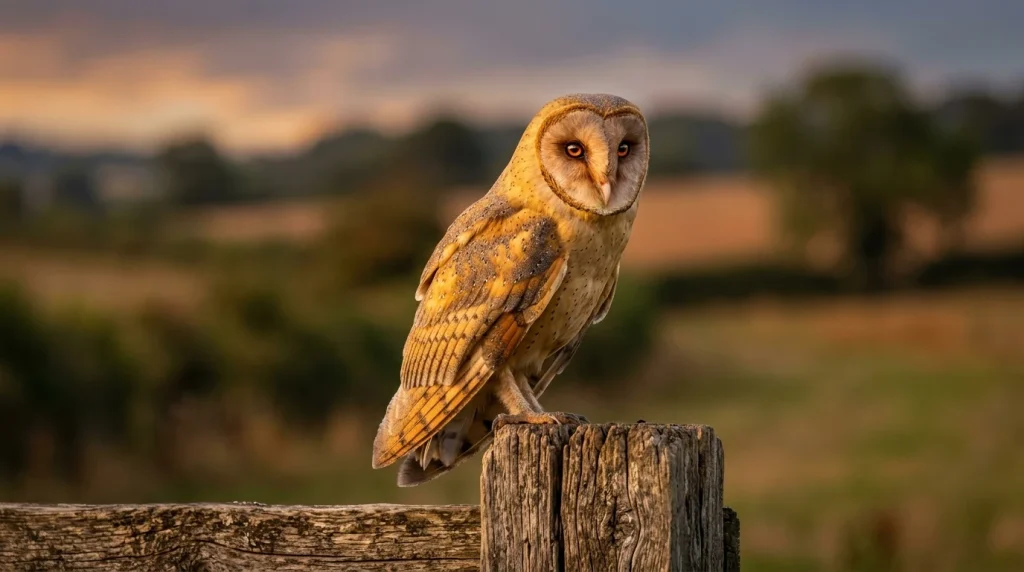
- Family Tytonidae (Barn and Bay Owls): Comprising roughly 20 recognized species across two genera (Tyto and Phodilus), barn owls are characterized by distinct heart-shaped facial discs, relatively small dark eyes, long slender legs, and a serrated pectinate middle claw specialized for preening and parasite removal. They lack ear tufts and possess a unique sternum fused to the furcula.
- Family Strigidae (True Owls / Typical Owls): Representing over 230 extant species across nearly 30 genera, true owls feature circular facial discs, robust bodies, large round heads, and extraordinary morphological diversity. Size extremes range from the diminutive Elf Owl (Micrathene whitneyi), weighing barely 40 grams, to the massive Blakiston’s Fish Owl (Bubo blakistoni) and Eurasian Eagle-Owl (Bubo bubo), which can exceed 4 kilograms in body mass.
Evolutionary Anatomical Adaptations for Nocturnal Predation
Owls possess an extraordinary suite of morphological and physiological adaptations engineered to conquer the nocturnal niche:
| Anatomical System | Morphological Specialization | Biomechanical & Physiological Function |
|---|---|---|
| Ocular Architecture | Elongated tubular eyes supported by bony sclerotic rings; dense retinal rod concentration; tapetum lucidum. | Maximizes light gathering and focal length; provides exceptional stereoscopic binocular vision across low-light environments. |
| Facial Disc Ruff | Stiff, parabolic feather disc controlled by specialized subcutaneous facial muscles. | Acts as an acoustic satellite dish, collecting and focusing high-frequency sound waves into the external ear openings. |
| Asymmetric Auditory Canals | Vertical displacement between left and right ear openings on the skull structure. | Generates microsecond interaural time and intensity differences, enabling 3D acoustic triangulation of prey in pitch darkness. |
| Silent Flight Aerodynamics | Leading-edge serrated comb (fluting), soft velvety dorsal down, and porous trailing edge fringes. | Disrupts airflow turbulence and suppresses vortex shedding, eliminating sound waves across mammalian auditory frequencies. |
| Talon Biomechanics | Reversible fourth outer digit (semi-zygodactyl foot); raptorial talons capable of high crushing force. | Enables instantaneous transition from a 3-forward/1-back perching grip to a 2-forward/2-back prey-capturing clamp. |
Cervical Mobility: How Owls Rotate Their Heads 270 Degrees
Because an owl’s tubular eyes are rigidly anchored inside bony sclerotic rings, they cannot rotate their eyeballs within the orbits. To survey their surroundings, owls evolved extraordinary cervical mobility, rotating their heads up to 270 degrees horizontally and 180 degrees vertically without compromising vascular circulation to the brain:
- 14 Cervical Vertebrae: Owls possess 14 neck vertebrae—twice the number found in mammals—creating a multi-jointed, flexible kinetic column.
- Expanded Transverse Foramina: The bony canals that guide the vertebral arteries through the neck bones are nearly ten times wider than the blood vessels, preventing mechanical pinching during extreme rotational torsion.
- Carotid Blood Reservoirs & Anastomoses: Contractile pooling reservoirs at the base of the skull (the trigeminal and carotid retia) maintain steady blood flow to the brain even when arterial vessels are momentarily compressed.
Digestive Physiology and Pellet Regurgitation
Unlike diurnal birds of prey, owls have a relatively non-acidic gastric pH (2.2 to 2.5), meaning bones, teeth, fur, feathers, and insect chitin pass through the stomach undigested. Within the muscular gizzard (ventriculus), non-digestible elements are compressed into a compact, oval bolus known as a pellet. Roughly 10 to 12 hours following consumption, reverse peristalsis propels the pellet upward through the proventriculus and esophagus, casting it out through the beak before the owl can feed again.
Global Survey of Iconic Owl Species
Owls inhabit virtually every terrestrial biome across the globe:
- Great Horned Owl (Bubo virginianus): The quintessential North American apex predator, capable of exerting over 300 psi of talon pressure to capture skunks, lagomorphs, and waterfowl.
- Snowy Owl (Bubo scandiacus): A circumpolar Arctic nomad adapted for diurnal tundra hunting, relying heavily on cyclical lemming population pulses.
- Barn Owl (Tyto alba): The world’s most widespread owl species, serving as a vital natural pest controller across agricultural ecosystems.
- Burrowing Owl (Athene cunicularia): A diurnal, terrestrial grassland specialist that nests in abandoned mammal burrows and mimics rattlesnake buzzes when threatened.
Conservation Challenges and Habitat Protection
Global owl populations face increasing threats from anthropogenic pressures, including deforestation, agricultural rodenticide poisoning, collisions with vehicles and power lines, and light pollution disrupting nocturnal hunting. Preserving old-growth hollow trees, installing dedicated artificial nesting boxes, and regulating chemical rodenticides are critical conservation priorities worldwide.
Frequently Asked Questions
Why do owls hoot?
Hooting serves as a primary vocalization for territorial defense, courtship advertising, and pair-bonding communication. However, vocalizations vary widely: barn owls emit harsh screeches, screech owls produce tremolo trills, and saw-whet owls whistle rhythmically.
Can an owl turn its head a full 360 degrees?
No bird can rotate its head 360 degrees. Owls can turn their heads up to 270 degrees in either direction, which provides an effective 360-degree field of view when combined with minimal body repositioning.
What is the difference between an owl and other raptors?
While sharing hooked beaks and sharp talons with hawks and eagles, owls belong to a separate evolutionary order (Strigiformes). They are distinguished by forward-facing tubular eyes, facial discs, silent wing feathers, and specialized nocturnal hunting physiology.
Get our latest guides, news, and insights highlighted in your Google Search & AI Overviews.