✨ This article was AI edited. Editorial responsibility: WorldBirds.eu.
Produced with AI. This article was artificially generated. Editorial responsibility: WorldBirds.eu.
In the fragile and resource-constrained landscapes of arid and semi-arid ecosystems, understanding trophic food webs is essential for biodiversity conservation. Among nocturnal apex predators, owls (order Strigiformes) serve as invaluable ecological bio-indicators. The determination of owl dietary preferences through pellet analysis provides a non-invasive, quantitative window into predator-prey dynamics, small mammal community structure, and desert ecosystem stability.
Physiology of Raptor Digestion and Pellet Formation
Unlike diurnal raptors that possess acidic stomachs capable of partially digesting bone, owls have a less acidic gastric pH (approximately 2.2 to 2.5). Consequently, the skeletal elements, teeth, keratinous claws, insect exoskeletons, and fur of ingested prey items remain completely intact. The digestion process follows a precise anatomical pathway:
- Proventriculus & Gizzard (Ventriculus): Food passes through the glandular proventriculus into the muscular ventriculus. Digestive enzymes break down muscle, viscera, and soft tissue, while non-digestible bones and fur are compressed by peristaltic contractions into a dense, rounded bolus.
- Regurgitation Cycle: The pellet is held in the gizzard until digestion is complete. Approximately 10 to 12 hours after feeding, reverse peristalsis forces the pellet back through the esophagus and out of the bill. An owl cannot ingest new prey while a pellet occupies its upper digestive tract.
Methodological Framework: Collecting and Dissecting Desert Owl Pellets
Rigorous dietary determination requires standardized field collection and laboratory processing protocols:
1. Field Collection & Roost Site Identification
In arid zones, pellets are collected beneath traditional roosting structures such as rocky cliff overhangs, abandoned adobe structures, desert wash trees (e.g., mesquite, ironwood), and saguaro cactus cavities. Fresh pellets exhibit a dark, glossy mucus sheen, whereas weathered pellets appear grey and dry.
2. Sterilization and Dry/Wet Dissection
To eliminate zoonotic pathogens and feather mites, pellets are autoclaved or baked at 90°C (195°F) for 4 hours, or soaked in a 0.5% sodium hydroxide (NaOH) or warm saline solution to dissolve fur without damaging fragile micro-mammal bone structures.
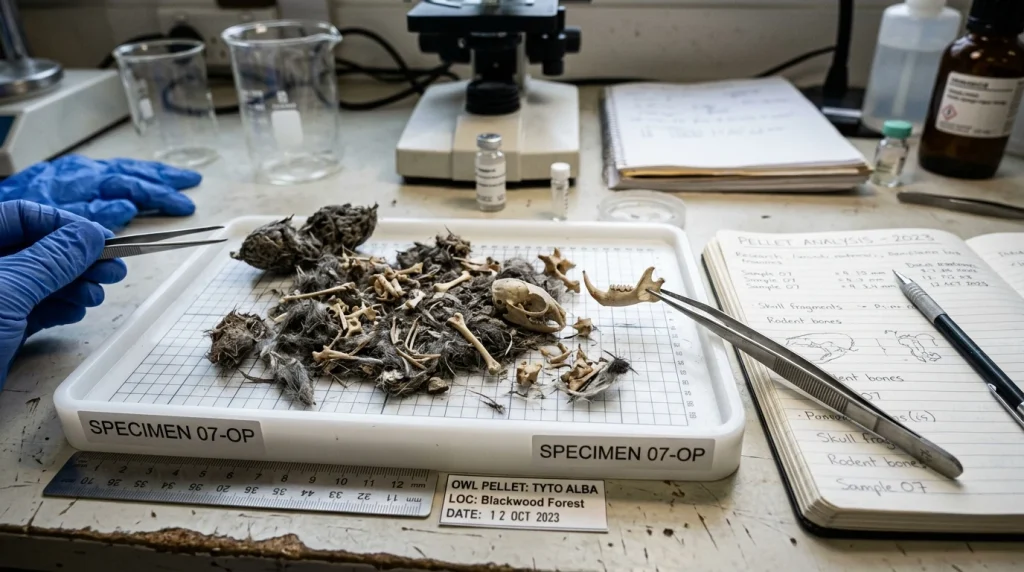
3. Osteological Cranial & Dental Taxonomy
Taxonomic identification relies on high-resolution magnification of intact crania, mandibular teeth, and diagnostic pelvic/humeral bones. Key diagnostic features in arid environments include:
- Molariform Dentition: Distinguishing between hypsodont rootless molars in voles and rooted, tuberculated teeth in desert pocket mice (Chaetodipus) and kangaroo rats (Dipodomys).
- Auditory Bullae: Massively enlarged auditory bullae indicate desert-adapted heteromyid rodents specialized for low-frequency acoustic detection of owl wingbeats.
- Mandibular Morphology: Dental formula and coronoid process angle are used to identify shrews (Soricidae) and desert bats.
Comparative Dietary Profiles in Arid Ecosystems
Dietary breadth varies significantly across sympatric owl species inhabiting arid and semi-arid biomes:
| Owl Species | Hunting Guild & Habitat | Primary Prey Categories | Key Biomass Contributors |
|---|---|---|---|
| Barn Owl (Tyto alba) | Open scrub, desert grassland, riparian edges; low quartering flight. | Small rodents (85–95%), bats, small birds, amphibians. | Pocket mice (Perognathus), kangaroo rats (Dipodomys), deer mice (Peromyscus). |
| Great Horned Owl (Bubo virginianus) | Canyon walls, rocky bluffs, woodland ecotones; sit-and-wait perching. | Medium mammals (60–80%), lagomorphs, reptiles, larger birds. | Desert cottontails (Sylvilagus audubonii), black-tailed jackrabbits, skunks. |
| Burrowing Owl (Athene cunicularia) | Arid plains, agricultural margins, prairie dog towns; diurnal & crepuscular ground hunting. | Arthropods (50–70% by count), small lizards, micro-rodents. | Darkling beetles (Tenebrionidae), scorpions, grasshoppers, harvest mice. |
| Elf Owl (Micrathene whitneyi) | Saguaro cactus forests, desert riparian washes; aerial hawking & gleaning. | Invertebrates (>95%), small geckos, scorpions. | Sphinx moths, centipedes, crickets, solifugids. |
Quantitative Trophic Indices in Ecological Analysis
Converting raw bone counts into ecologically meaningful dietary metrics requires three fundamental statistical indices:
1. Minimum Number of Individuals (MNI)
MNI is determined by counting diagnostic paired elements (e.g., left vs. right dentaries, upper crania) for each identified taxon:
$$\text{MNI} = \max(\text{Left Mandibles}, \text{Right Mandibles}, \text{Crania})$$
2. Relative Biomass Contribution (%B)
Because a single desert jackrabbit provides vastly more energy than thirty tenebrionid beetles, numerical counts alone distort trophic reality. Multiplying MNI by the mean adult body mass of each prey species yields the actual biomass share:
$$\%B_i = \frac{\text{MNI}_i \times \text{Mass}_i}{\sum (\text{MNI}_j \times \text{Mass}_j)} \times 100$$
3. Shannon-Wiener Trophic Diversity ($H’$)
The niche breadth of the predator population across seasonal fluctuations is quantified as:
$$H’ = -\sum_{i=1}^{S} p_i \ln(p_i)$$
Where $p_i$ represents the proportion of total biomass contributed by prey species $i$. A high $H’$ reflects an opportunistic generalist predator, while a low $H’$ indicates a specialized rodent predator vulnerable to prey population crashes.
Pellet Analysis as a Non-Invasive Ecological Monitoring Tool
Beyond studying raptor biology, long-term pellet caches in desert caves and dry washes offer historical and contemporary ecological data:
- Small Mammal Inventorying: Owl pellets regularly reveal rare or elusive nocturnal mammal species (such as desert shrews or grasshopper mice) that consistently evade standard Sherman live-trapping grids.
- Climate Change & Desertification Tracking: Longitudinal shifts from mesic rodent species toward hyper-arid heteromyid species in pellet records provide early warnings of regional drying and habitat degradation.
- Ecotoxicology & Heavy Metals: Bone and keratin matrixes in pellets can be analyzed via spectrometry to monitor bioaccumulation of anticoagulant rodenticides and heavy metals through the trophic chain.
Frequently Asked Questions
Why are owl pellets better for diet analysis than feces?
Owl feces consist almost entirely of liquid uric acid and digested soft tissues, containing no identifiable prey remnants. Pellets contain pristine, unfragmented skeletal and dental elements that allow precise species-level identification.
Do all owl species produce pellets of the same size?
No. Pellet dimensions scale with body size: Barn Owl pellets average 4 to 6 cm in length, Great Horned Owl pellets reach 7 to 10 cm, while small Elf or Screech Owl pellets measure only 1.5 to 2.5 cm.
How often do wild owls regurgitate pellets?
Most wild owls regurgitate one to two pellets every 24 hours, typically ejecting a pellet at their daytime roost before embarking on evening hunting forays.
Get our latest guides, news, and insights highlighted in your Google Search & AI Overviews.