✨ This article was AI edited. Editorial responsibility: WorldBirds.eu.
Produced with AI. This article was artificially generated. Editorial responsibility: WorldBirds.eu.
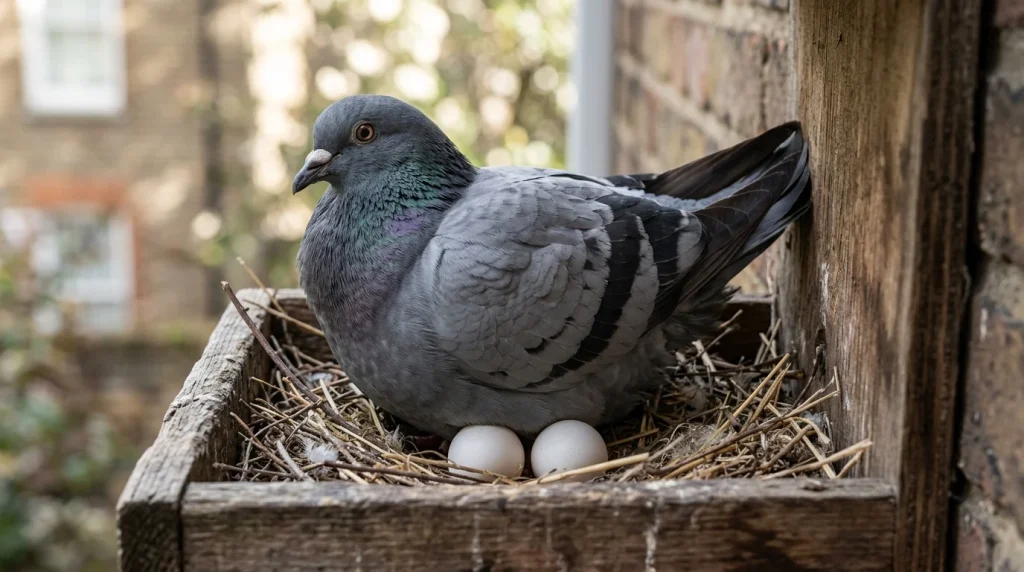
If you have observed pigeons nesting on a balcony ledge, windowsill, or in a backyard loft, you have likely marveled at their relentless brooding dedication. Determining exactly how long a pigeon sits on her eggs before they hatch is a foundational question in columbid reproductive biology. While the short answer is typically 17 to 19 days, the underlying parental schedule, shift-sharing mechanics, hormonal regulation, and incubation physiology reveal a sophisticated cooperative breeding system unique in the avian kingdom.
The Incubation Timeline: From Laying to Hatching
Pigeons (Columba livia) have a standardized, highly predictable reproductive cycle consisting of distinct reproductive phases:
| Reproductive Phase | Exact Timing | Key Parental & Embryonic Events |
|---|---|---|
| First Egg Laid | Day 0 (Late afternoon ~5:00 PM) | Female lays the first egg; parents lightly guard but do NOT initiate continuous hard incubation. |
| Second Egg Laid | Day 2 (~40 to 44 hours later) | Female lays the second egg; full, continuous hard incubation begins immediately. |
| Early Incubation | Days 3 to 7 | Cardiovascular network forms; male and female establish strict daily shift rotation. |
| Mid Incubation | Days 8 to 14 | Cartilage ossification and feather tract formation; steady egg turning every 45–60 minutes. |
| Internal Pipping | Day 17 | Embryos break into air cells; parents vocalize softly to bond with unhatched squabs. |
| External Pipping & Hatch | Days 18 to 19 | Egg shells breached; both squabs emerge within 12 to 24 hours of each other. |
The Shift-Sharing Parental Dynamic: Who Sits When?
A common misconception among casual bird observers is that the mother pigeon sits on the eggs continuously for nearly three weeks. In reality, pigeons practice obligate biparental incubation with strict, circadian-regulated shift handoffs:
- The Male Shift (Mid-Morning to Late Afternoon): The male cock bird takes over incubation around 9:30 AM to 10:00 AM and broods continuously until approximately 4:00 PM to 5:00 PM. During this window, the female leaves the nesting area to forage for protein-rich seeds, drink, bathe, and bask in the sun to replenish calcium reserves.
- The Female Shift (Late Afternoon Through Overnight): The female hen incubates from roughly 5:00 PM throughout the entire night until handing back duty the next morning. She shoulders roughly 16 hours of continuous nocturnal brooding, protecting eggs from cold night air, wind drafts, and nocturnal predators.
This division of labor ensures that the eggs remain at a constant physiological temperature of 37.5°C (99.5°F) with zero chilling periods, while allowing both partners adequate time to maintain physical body condition.
Why Both Eggs Hatch Simultaneously: The 44-Hour Gap Secret
Female pigeons invariably lay a clutch of two eggs spaced approximately 40 to 44 hours apart. If the parents initiated hard brooding immediately after the first egg was laid, the first-born squab would hatch nearly two days ahead of its sibling. In altricial birds receiving crop milk, a 48-hour head start creates an insurmountable size disadvantage, often leading to the starvation or trampling of the younger chick.
To prevent this, pigeons exhibit delayed incubation behavior. The parents merely stand over or loosely warm the first egg, keeping its core temperature below the physiological developmental threshold of 24°C (75°F). Once the second egg is deposited, full body contact and brood patch vasodilation occur, synchronizing embryonic development so that both eggs hatch within hours of each other.
The Brood Patch: Avian Thermo-Regulation in Action
Pigeons transfer heat to their clutch through specialized anatomical regions known as brood patches (incubation patches). In response to elevated circulating estrogen and prolactin levels during mating and laying:
- Down feathers on the lower breast and abdominal region fall out, exposing bare epidermal skin.
- Subcutaneous blood vessels proliferate and dilate, creating an extensive vascular bed capable of transferring maternal core body temperature directly to the eggshell.
- The skin becomes thickened and edematous (fluid-filled), acting as a flexible, biological heating pad that contours precisely around the oval curvature of the eggs.
Hormonal Regulation of Brooding & Crop Milk Production
The brooding drive in pigeons is controlled by the pituitary hormone prolactin. Throughout the 17-to-19-day incubation period, prolactin levels rise steadily in both male and female birds. This hormonal surge accomplishes two vital functions simultaneously:
- It suppresses gonadotropin-releasing hormone, halting further egg laying and maintaining fierce nesting focus.
- During the final 48 hours before hatching (around Day 16), it stimulates the lateral lobes of the crop epithelial lining to hyper-proliferate, manufacturing lipid-rich and protein-dense crop milk ready for regurgitation the moment the squabs breach their shells.
Environmental and Seasonal Factors Influencing Sitting Duration
While 17 to 19 days is the physiological average, several environmental factors can alter incubation length:
- Ambient Winter Temperatures: In severe winter conditions, eggs lose heat more rapidly during parental shift transitions, occasionally extending incubation to 20 or 21 days.
- Extreme Summer Heat: In hot climates (>38°C / 100°F), parent pigeons shift from warming to actively shading and ventilating eggs to prevent lethal hyperthermia.
- First-Time Breeder Inexperience: Young pairs may occasionally fail to rotate shifts smoothly or leave eggs exposed for extended periods, resulting in delayed development.
- Nest Micro-climate: Nests built in sheltered masonry cavities retain thermal stability better than exposed balcony rails or wire baskets.
Nesting Site Selection: Urban Adaptation vs. Wild Cliff Ecology
The rock dove’s ancestral habitat of Mediterranean sea cliffs and mountain ledges predisposed pigeons to thrive in modern urban environments. Building cornices, air-conditioning ledges, bridges, and sheltered lofts mimic limestone crevices. Pigeons build notoriously minimalist, flat nests using twigs, wire scraps, and straw, relying on their own bodies to secure the eggs against rolling off precarious heights.
What to Do If Pigeon Eggs Haven’t Hatched After 21 Days
If a nesting pair has been sitting continuously for more than 21 to 22 days without signs of pipping, the eggs are almost certainly non-viable (due to infertility, bacterial contamination, or early embryonic mortality). In wild or feral nests, do not intervene; the parents will naturally abandon the unhatched clutch after 22 to 24 days and begin recycling for their next brood cycle. For domestic loft keepers, candling on Day 18 provides definitive confirmation before removing dud eggs.
Frequently Asked Questions
Do male pigeons also sit on eggs?
Yes. Male pigeons actively incubate the clutch every single day, typically taking over the nest from mid-morning (around 10:00 AM) until late afternoon (around 4:30 PM).
Can a pigeon leave her eggs unattended?
Parent pigeons rarely leave eggs unattended for more than 5 to 10 minutes. If both parents are absent for extended periods, it usually indicates disturbance by predators or severe distress.
What happens right after the eggs hatch?
Immediately upon hatching, the parents eat or carry away the empty eggshells to maintain hygiene and prevent predator detection. Within 2 to 4 hours, both parents begin feeding the hatchlings nutrient-dense crop milk.
Get our latest guides, news, and insights highlighted in your Google Search & AI Overviews.