✨ This article was AI edited. Editorial responsibility: WorldBirds.eu.
Produced with AI. This article was artificially generated. Editorial responsibility: WorldBirds.eu.
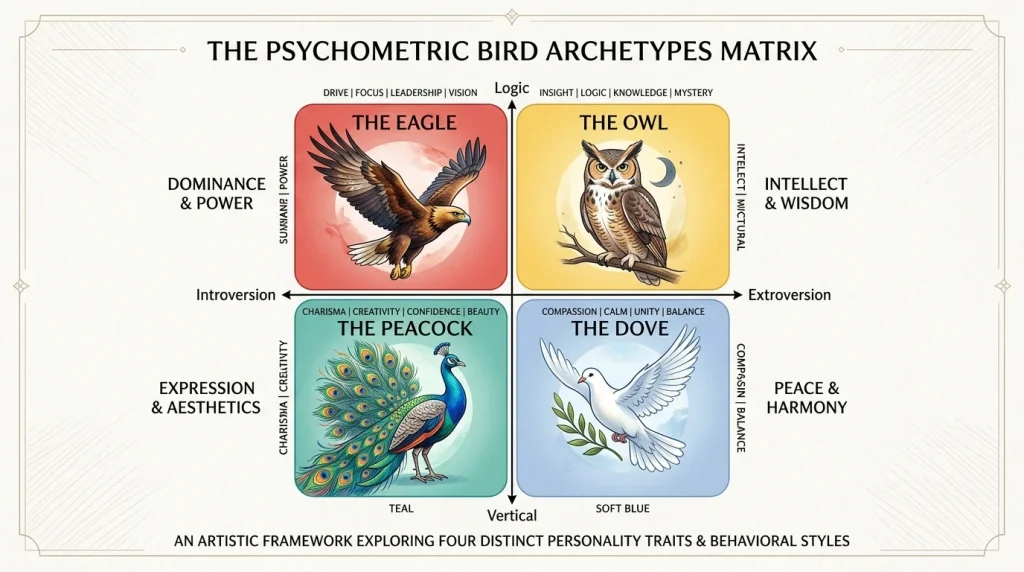
In the fields of occupational psychology, executive coaching, leadership development, and team building across the United Kingdom, psychometric behavioral models play an essential role in fostering workplace efficiency. Among the most intuitive, engaging, and memorable psychometric frameworks is the Bird Personality Questionnaire (UK). Mapping human behavioral styles onto four distinct avian archetypes—the Eagle, the Owl, the Peacock, and the Dove—this framework translates complex behavioral dynamics into practical, actionable collaboration strategies.
Origins and Conceptual Framework of the 4-Bird Typology
The four-quadrant bird personality model traces its theoretical lineage to William Moulton Marston’s 1928 DISC model and Carl Jung’s psychological types. While traditional corporate assessments often rely on abstract four-letter acronyms or statistical jargon, the UK Bird Personality Matrix provides an immediate, relatable metaphor by evaluating two fundamental behavioral axes:
- Pace of Action & Decision Making (Vertical Axis): Fast-paced, assertive, and proactive versus deliberate, reflective, and cautious.
- Core Orientation & Energy Focus (Horizontal Axis): Task, logic, and outcome-oriented versus people, relationship, and harmony-oriented.
| Avian Archetype | Primary Behavioral Style | Core Workplace Driver | Key Leadership Strength | Potential Friction / Blind Spot |
|---|---|---|---|---|
| The Eagle (Dominance / Driving) | Fast-paced & Task-focused | Results, control, winning, autonomy, measurable progress. | Decisive strategic vision, bold initiative, crisis resolution. | Impatience, blunt communication, intolerance of deliberation. |
| The Peacock (Influence / Expressive) | Fast-paced & People-focused | Social recognition, creative innovation, enthusiasm. | Charismatic communication, team motivation, networking. | Disorganization, impulsivity, follow-through challenges. |
| The Dove (Steadiness / Amiable) | Deliberate & People-focused | Harmony, security, trust, consensus, mutual loyalty. | Empathetic listening, dependable collaboration, mediation. | Conflict avoidance, passive resistance to rapid change. |
| The Owl (Conscientiousness / Analytical) | Deliberate & Task-focused | Accuracy, logic, systematic order, high-quality standards. | Precision, data-driven analysis, rigorous risk auditing. | Analysis paralysis, perfectionism, reluctance to delegate. |
Detailed Breakdown of the Four UK Bird Archetypes
1. The Eagle: The Bold Strategist
Eagles are visionary, goal-driven leaders who focus relentlessly on the bottom line. They thrive in fast-paced, high-stakes environments, prefer concise executive summaries over granular spreadsheets, and view obstacles as challenges to be overcome. In UK business cultures, Eagles excel in turnaround management, business development, and entrepreneurial ventures.
2. The Peacock: The Charismatic Influencer
Peacocks are optimistic, energetic, and expressive communicators who generate creative ideas and foster team morale. They excel in public relations, marketing, creative design, and sales. Peacocks value public praise and open collaboration, using emotional intelligence to inspire stakeholders.
3. The Dove: The Empathetic Harmonizer
Doves represent the relational backbone of any successful organization. Calm, patient, and deeply loyal, Doves prioritize team well-being and consensus building. They thrive in human resources, customer service, healthcare, and administrative coordination, ensuring steady execution without unnecessary drama.
4. The Owl: The Rigorous Analyst
Owls are methodical, detail-oriented thinkers who govern quality control and risk management. They respect empirical data, systematic processes, and logical consistency. In fields like financial auditing, software engineering, scientific research, and compliance, Owls ensure that ambitious plans are structurally sound.
Sample Self-Assessment Questionnaire & Scoring Protocol
To determine your dominant avian behavioral profile, evaluate the following ten reflective situational questions on a scale from 1 (Strongly Disagree) to 5 (Strongly Agree):
- Question 1: When faced with an urgent crisis, I immediately take charge and assign direct tasks to team members without hesitation. (Measures Eagle Dominance)
- Question 2: I feel most energized when presenting creative concepts to large groups and inspiring people through stories. (Measures Peacock Influence)
- Question 3: Preserving team harmony and ensuring everyone feels heard is more important to me than rushing to meet an aggressive deadline. (Measures Dove Steadiness)
- Question 4: I thoroughly double-check data sets and verify methodology before signing off on any final operational report. (Measures Owl Conscientiousness)
- Question 5: I get frustrated by long, drawn-out meetings that lack clear action points or definitive timelines. (Measures Eagle Dominance)
- Question 6: I enjoy brainstorming spontaneous, unconventional solutions and building professional networks at industry conferences. (Measures Peacock Influence)
- Question 7: I prefer predictable, structured workflows and long-term collaborative working relationships over rapid structural reorganizations. (Measures Dove Steadiness)
- Question 8: Logical accuracy, adherence to compliance standards, and risk mitigation take precedence over emotional arguments in my decision-making. (Measures Owl Conscientiousness)
- Question 9: I am willing to challenge conventional wisdom and take calculated risks if it guarantees a substantial strategic competitive advantage. (Measures Eagle Dominance)
- Question 10: Colleagues frequently come to me for empathetic counsel, mediation, and steady, calming support during stressful organizational periods. (Measures Dove Steadiness)
Administration, Scoring, and Behavioral Flexibility
A standard UK Bird Personality Questionnaire tabulates composite scores across all four quadrants:
- Primary and Secondary Wings: Most professionals demonstrate a primary dominant archetype accompanied by a complementary secondary wing (e.g., Eagle-Owl for pragmatic project managers, or Dove-Peacock for community facilitators).
- Behavioral Fluidity: Highly effective leaders cultivate the ability to ‘flex’ into different bird quadrants depending on situational demands—adopting Eagle directness during critical deadlines or Dove empathy during sensitive team reviews.
Applications in Modern UK Organizations
UK corporate enterprises, educational institutions, and public sector bodies leverage bird personality testing for multiple organizational applications:
- Cross-Functional Collaboration: Bridging the communication divide between data-focused Owls and visionary Eagles.
- Optimized Team Construction: Creating balanced project teams that encompass innovation (Peacock), strategy (Eagle), execution quality (Owl), and cohesion (Dove).
- Recruitment and Career Pathways: Helping job candidates identify work cultures and roles that align naturally with their cognitive and behavioral strengths.
Frequently Asked Questions
Can an individual’s bird personality profile change over time?
Yes. While underlying core traits remain relatively consistent, professional growth, mentorship, life milestones, and deliberate skill acquisition can significantly modify situational behavioral responses.
Is the Bird Personality Questionnaire a clinical diagnostic test?
No. The Bird Personality Questionnaire is a normative coaching and self-development instrument designed for professional collaboration and personal awareness, not a clinical diagnostic assessment.
What happens when all team members share the same bird archetype?
Homogeneous teams frequently encounter severe operational blind spots—a team of only Eagles may suffer constant power struggles, while a team of only Owls may stall in endless analysis paralysis without taking action.
Get our latest guides, news, and insights highlighted in your Google Search & AI Overviews.